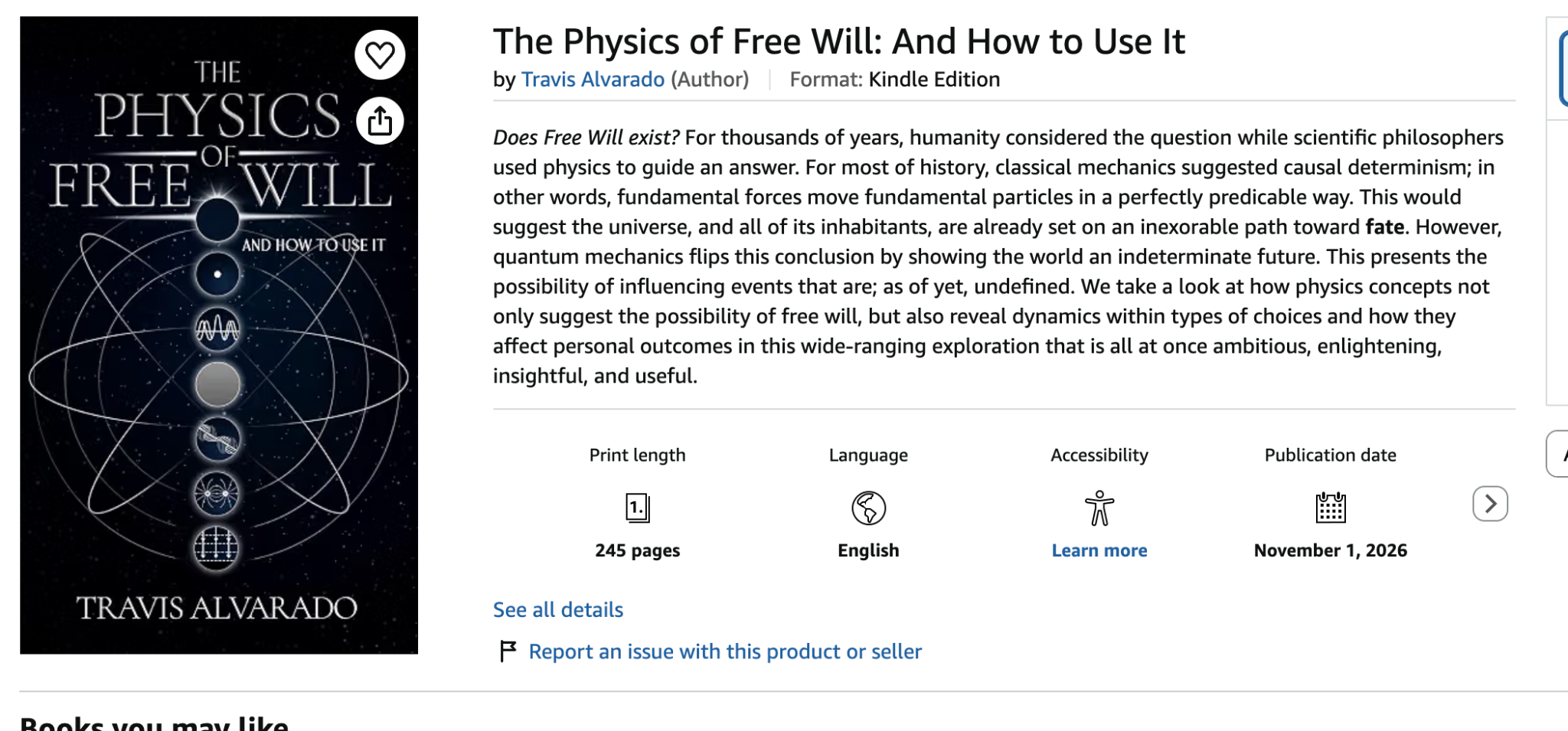
A new book by Travis Alvarado

The Physics
of Free Will

And How to Use It

"What if free will isn't an illusion — but a quantum phenomenon?"

For 2,000 years philosophers argued about determinism and free will. Then quantum mechanics shattered certainty. This book explores what happened next — and what it means for how you live your life today.

The Physics of Free Will book cover

Why This Book Exists

St. Augustine asked about free will in 400 AD. Newton built a clockwork universe. Laplace turned that clockwork into destiny. Quantum mechanics shattered certainty. This book explores what happened next.

"The present is the effect of its past and the cause of its future."

— Pierre-Simon Laplace, 1814

"If you think you understand quantum mechanics, then you don't."

— Richard Feynman

"Do I contradict myself? Very well then, I contain multitudes."

— Walt Whitman

Does Free Will Exist?

For thousands of years, humanity considered the question while scientific philosophers used physics to guide an answer. For most of history, classical mechanics suggested causal determinism; in other words, fundamental forces move fundamental particles in a perfectly predictable way. This would suggest the universe, and all of its inhabitants, are already set on an inexorable path toward fate.

However, quantum mechanics flips this conclusion by showing the world an indeterminate future. This presents the possibility of influencing events that are, as of yet, undefined. We take a look at how physics concepts not only suggest the possibility of free will, but also reveal dynamics within types of choices and how they affect personal outcomes in this wide-ranging exploration that is all at once ambitious, enlightening, insightful, and useful.

12
Chapters from classical to quantum physics
7
Chakras mapped to laws of nature
2,600
Years of philosophy covered
1
Question at the center of everything

Science and Spirituality, Together

This book doesn't require a physics degree or a spiritual practice. It requires only curiosity about the biggest question there is.

Readers who enjoy

Sam Harris · Alan Watts · Viktor Frankl · Carl Jung · Brian Greene · Carlo Rovelli · Joe Dispenza · James Clear

2,600 Years of One Question

400 AD
Augustine
Asks: can free will exist if God knows the future?
1687
Newton
Builds a clockwork universe of gravity and motion
1814
Laplace
Causal determinism: with perfect knowledge, the future is fixed
1905
Einstein
Relativity: space and time are not absolute
1927
Heisenberg
Uncertainty principle: perfect knowledge is impossible
1935
EPR Paradox
Entanglement: reality is non-local
Now
Quantum Free Will
What does it all mean for how we choose to live?

Seven Chakras. Seven Laws of Physics.

I

Survival Release Fear Universal Gravitation

II

Pleasure Forgive Yourself Electrostatics

III

Willpower Accept Yourself Electromagnetism

IV

Love Love Yourself & Others No Formula Exists

V

Truth Live Truthfully Quantum Mechanics

VI

Wisdom Embrace Oneness Fractal Consciousness

VII

Detachment Let Go Consciousness

Free Preview

Read Chapter 1 Free

St. Augustine, 400 AD, Roman North Africa. A man who will shape all of Western civilization asks a question that physics is still trying to answer. Enter your email and we'll send it to you.

Read Chapter 1 Free

Enter your email and we'll send it to you.

    No spam. Unsubscribe at any time.

    The Journey

    1

    Opening Question

    St. Augustine Asks the Question

    400 AD, Roman North Africa. A theologian grapples with whether free will can exist alongside God's perfect knowledge of the future — the question that still drives physics today.

    Philosophy
    2–3

    The Framework

    Chakras, Laws, Physics, Advice

    The happiness derivative, self-fulfilling emotions, and the four-part structure: each chakra connected to a natural law, a force in physics, and practical guidance.

    Framework
    4–6

    Part One — Classical Mechanics

    Survival, Pleasure, Willpower

    Gravity, electrostatics, and electromagnetism as mirrors for fear, desire, and the will to create. The Law of Attraction as a physics equation. The Law of Orthogonality and why you can't pursue money directly.

    Classical Physics
    7

    Interlude — Determinism Philosophy

    Laplace and Causal Determinism

    If classical mechanics is complete, then free will is an illusion. Laplace's demon, the perfectly predictable universe, and the case for fate.

    Determinism
    8

    The Center

    Love Yourself and Others

    Love sits outside both physics frameworks. There is no formula for it — and that is precisely the point.

    Love
    9–11

    Part Two — Quantum Mechanics & Consciousness

    Truth, Wisdom, Detachment

    Heisenberg's uncertainty principle, the double slit experiment, EPR entanglement, the fractal nature of the universe, and what physics and consciousness have in common.

    Quantum Physics
    12

    The Revision

    Quantum Free Will

    Free will may exist as a quantum mechanical tilt of the odds — not a Newtonian override of the universe, but a real, probabilistic, chosen influence on what happens next. Perhaps we roll the dice.

    Conclusion
    Travis Alvarado, author of The Physics of Free Will

    Travis Alvarado

    BS, General Theoretical Physics, University of Texas at Austin · Enterprise Account Executive · Author

    Travis Alvarado holds a Bachelor's in General Theoretical Physics from the University of Texas at Austin, has performed research at the University of Washington Department of Aeronautics and Astronautics, and has published research in prestigious peer-reviewed physical journals.

    He has spent fifteen years as an Enterprise Account Executive selling technology solutions to large corporations and government entities. Through mastery of hard science and soft psychology, he synthesized a fresh address to one of the oldest questions — one that is logically rigorous while distilling specific insights that can be effectively applied in real life.

    Podcast Interviews Book Clubs Speaking Philosophy Groups Press Inquiries
    Paperback
    Format
    & Ebook
    Also Available
    2025
    Publication Year
    $17.99
    Paperback Price
    $8.99
    Ebook Price
    Philosophy · Physics
    Categories
    Consciousness · Growth
    Also Filed Under

    Do we have free will?

    Paperback and ebook available now on Amazon.

    Order on Amazon Kindle Edition Request a Signed Copy

    Paperback $17.99  ·  Ebook $8.99

    Print on Demand
    Ships via Amazon
    Instant
    Kindle Delivery
    Worldwide
    Distribution
    Free Returns
    Amazon Policy